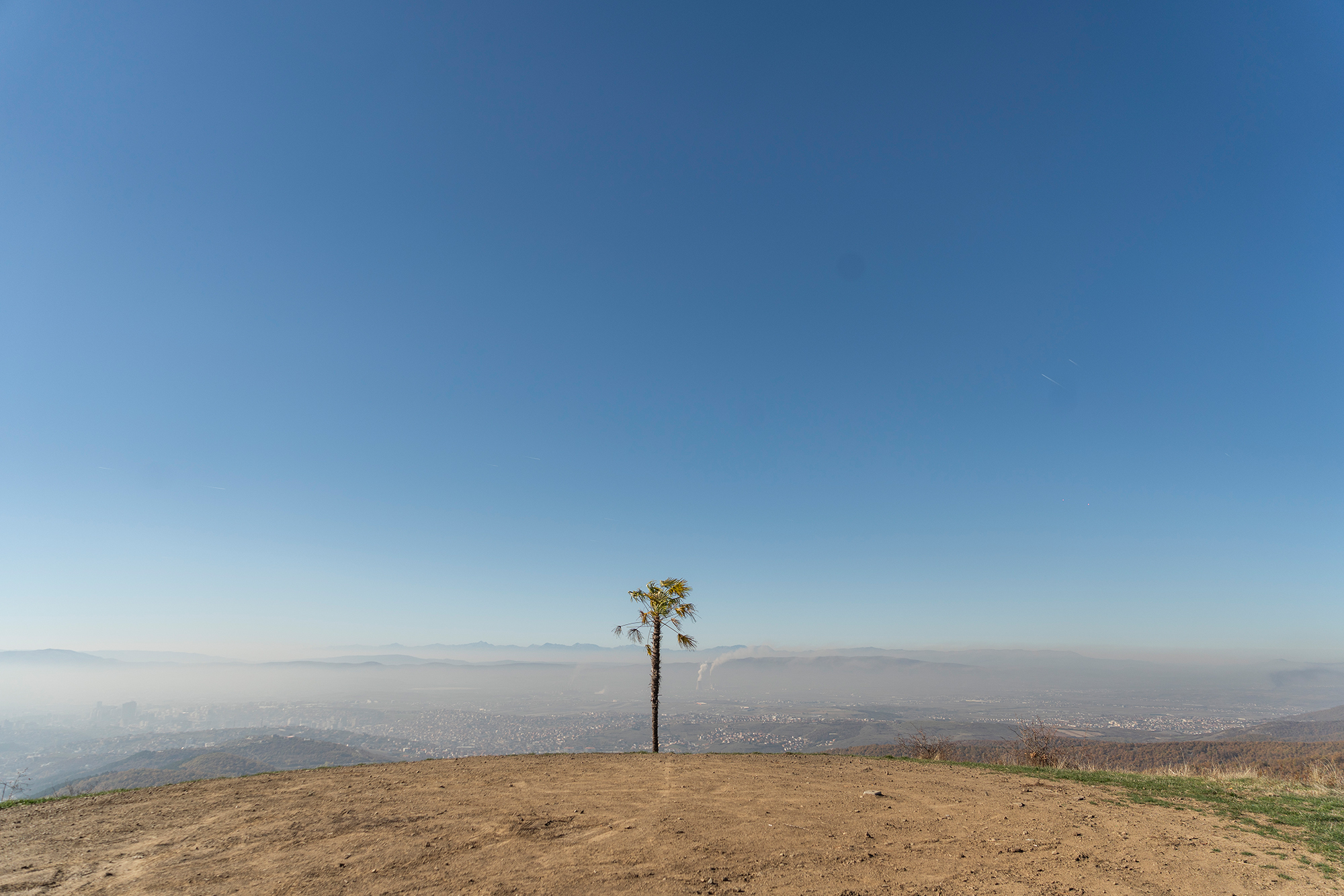
Driton Selmani’s Nobody Saw This Coming brings an unexpected intervention: a solitary, unwavering palm tree appears as a surprise manifestation on the land of On Top Residency. Its shadow moves slowly, like a cloud that follows the clock, yet simultaneously generates a black circle on the ground—a quiet recreation of suprematism, not as an abstract form detached from reality, but as evidence produced by time itself. The shadow does not represent; it accumulates, operating as an affective structure that insists on presence through duration rather than spectacle.¹
This is not simply a cloud or a shadow, but a symbolic act: an intervention that places a pure, almost metaphysical form onto a tense terrain. Selmani constructs a symbolism that challenges the site where it stands and the definitions that site attempts to hold. The palm operates as a displaced signifier—never fully assimilated, never entirely rejected—echoing the idea of identity as something perpetually in formation, positioned rather than fixed.²
According to Selmani, “this work stands as an alien body in a land that does not love it.” This tension between the alien and the present becomes the substance of the work itself: an object that does not belong, yet insists on staying—a space without place that nonetheless takes place. Rooted yet unwanted, visible yet unsupported, the palm persists as an embodied contradiction, where existence within an unaccommodating structure becomes an act of resistance rather than adaptation.³
The palm is not merely a tree; it is an act that raises direct questions. How difficult is it to survive in a place that lacks an infrastructure capable of recognizing the transformative power of art? How can something grow when it is not nourished by understanding, but by neglect? In contexts where the most innovative impulses of society are discouraged, where ideas that fall outside the dominant scheme are treated as excess, Selmani’s work emerges as both resistance and persistence—something sown despite the conditions.
Through this work, On Top Residency articulates a clear and urgent vision: can we imagine a sculpture park in this country? A space where artworks do not vanish with the closing of an exhibition, but remain as permanent forms of dialogue—with the land, with the community, and with the future.
The original exhibition text was authored by Fatmir Mustafa – Karllo. An expanded version was later prepared by Alex F. Koenig.
² Stuart Hall’s conception of cultural identity emphasizes positioning over essence, understanding identity as a continuous process shaped by history, power, and context rather than as a stable or resolved condition. The palm tree’s displacement mirrors this instability, refusing both full integration and total exclusion.
³ Frantz Fanon’s writings on alienation and the experience of inhabiting structures not designed to sustain difference illuminate the palm’s condition as an “alien body.” Its presence reflects Fanon’s insistence that persistence itself can become a form of resistance when harmony is structurally impossible.
Nobody Saw This Coming, 2025 Planted Trachycarpus fortunei, 600 × 100 × 50 cm Installation view: On Top Residency, Prishtina Courtesy of the artist © Images: Ferdi Limani